I grew up with the same coffee that many of you did. Somewhere between something that was mountain grown, and the local cup of Joe that could have been substituted for paint thinner. This was the time when coffee mumbled. Unintelligible mutterings that continue to linger in many dank holes today... but let us go back....
There was this generic coffee flavor that we linked with all coffee. Aromatic, yet bitter, deep, but unremarkable, character, yet sameness. Whether it be the standard Colombian or something exotic like Kenya... it pretty much all tasted the same. And when it was different, we tried to mirror that sameness by matching the preconceived coffee flavor in the dark recesses of our mind by flattening out the bitters, sharp tones, and burnt staleness by a glob of sugar and a plop of milk. As we created some artificial semblance of coffee like flavor, we were satisfied that we could take something that was unpalatable and make it... well, recognizably average.
There are a growing number of farmers, roasters, and coffee professionals that hear the bean speaking to them. At first, it was some coded language, but it was the farmers who first understood that although the beans shared a common history, they had all developed their own language. Coffee speaks to us, but not in words, or sounds, or symbols. Coffee speaks to us in flavors.
As we listen to what the bean is telling us, we can learn, through cupping, and by maintaining a varietal roast what stories they have to share. The history of the cultivar, the feeling of the land, the heart of the farmer, the care of the millers and the sorters, the science and skill of the roaster, and the love and passion of the barista all combine to tell the story of each coffee to the world.
Each cup we serve speaks volumes, and like a pristine first edition, we savor every word as it linguistically flavors our tongue. So when you have a moment to savor the unspoken word of coffee, educate yourself by the cup and pass on your knowledge to others by sharing a taste of the varietal language of coffee.
Sunday, December 14, 2008

Friday, November 07, 2008

Saturday, November 01, 2008
The Siphon Bar
We are just finishing our second week with the siphon bar at caffe d'bolla and the results are starting to come in.

The Siphon Bar has created a lot of new conversation about the coffee and the brewing method. I believe that this is the best way for extracting the dynamic varietal flavors out of the coffee.

Clean and dynamic
brewed above shimmering light
coffee perfection.
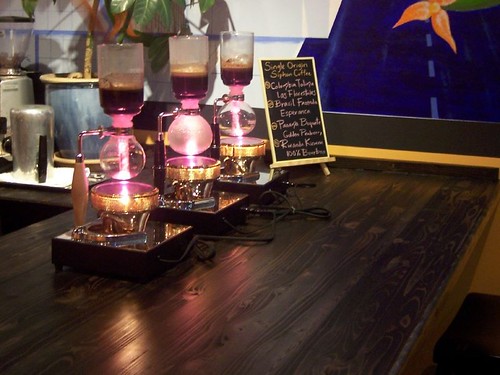
The Siphon Bar has created a lot of new conversation about the coffee and the brewing method. I believe that this is the best way for extracting the dynamic varietal flavors out of the coffee.

brewed above shimmering light
coffee perfection.
Saturday, October 25, 2008
Heart of the Forest Espresso - A Great Start!
On our caffe blog, I tell about our exclusive espresso blend for Tony Caputo's Market and Deli.
I stopped in to see Matt and Tony this afternoon, and as a brand new offering, the coffee and espresso is selling well. I'm roasting new coffee early this week, and it looks like it will be a great relationship.
I stopped in to see Matt and Tony this afternoon, and as a brand new offering, the coffee and espresso is selling well. I'm roasting new coffee early this week, and it looks like it will be a great relationship.
Saturday, August 23, 2008
Ethiopia Koratie DP -- in the Siphon
Wow!
This coffee was roasted to a dark city, almost full city roast... but I would do it at a lighter City roast next time to highlight the sweeter flavors.
In the cup the initial sips are blueberry up top and peach on the bottom. Midway through the cup a tiny hint of melon flavors begin to come through, though still surrounded by the blueberry.... and a bit of bitter cocoa in the background.
Blueberry and cocoa begin to dominate as you finish the cup. It finishes with a blueberry bittersweetness. I believe that the sweeter fruits would be more prominent and balanced at a lighter roast. I will report on that next time.
Total brew time on the siphon: 45 seconds - 35 brewing up, 10 to descend.
This coffee was roasted to a dark city, almost full city roast... but I would do it at a lighter City roast next time to highlight the sweeter flavors.
In the cup the initial sips are blueberry up top and peach on the bottom. Midway through the cup a tiny hint of melon flavors begin to come through, though still surrounded by the blueberry.... and a bit of bitter cocoa in the background.
Blueberry and cocoa begin to dominate as you finish the cup. It finishes with a blueberry bittersweetness. I believe that the sweeter fruits would be more prominent and balanced at a lighter roast. I will report on that next time.
Total brew time on the siphon: 45 seconds - 35 brewing up, 10 to descend.
If you're average and you know it...
... Clap your hands!
There are a relative handful of coffee shops that deliver a quality product and continue to push the envelope. They have knowledgeable and well-trained barista, they roast very good to phenomenal coffees or offer exquisite coffees from a top notch roaster/roasters.

Each of these shops continues to improve their craft and exhibits an eagerness to learn from the top down. These shops make it known that this is what they do, they stand behind it, and more often than not, they deliver in the cup. (Hey, nobody's perfect all of the time, it's the ability to learn and improve that separates the talkers from the doers. )
Now there are thousands upon thousands of coffee shops that confuse, dismantle, and lower the bar with every cup they serve. They source coffee based on price alone. They over roast or buy stale coffees from roasters selling at a discount. Each of these shops takes interest in trying to look cool while having no relevant information to pass to their customers, and their lack of skill and dismissive attitude at the craft of coffee is displayed from the top down.

I wonder? If so many coffeeshops work and train hard at being average and mediocre, why don't they profess it to the world? There seems to be a place in the market for these kinds of shops, so come clean and let the world know. If you're average and you know it, say it proud!
There are a relative handful of coffee shops that deliver a quality product and continue to push the envelope. They have knowledgeable and well-trained barista, they roast very good to phenomenal coffees or offer exquisite coffees from a top notch roaster/roasters.

Each of these shops continues to improve their craft and exhibits an eagerness to learn from the top down. These shops make it known that this is what they do, they stand behind it, and more often than not, they deliver in the cup. (Hey, nobody's perfect all of the time, it's the ability to learn and improve that separates the talkers from the doers. )
Now there are thousands upon thousands of coffee shops that confuse, dismantle, and lower the bar with every cup they serve. They source coffee based on price alone. They over roast or buy stale coffees from roasters selling at a discount. Each of these shops takes interest in trying to look cool while having no relevant information to pass to their customers, and their lack of skill and dismissive attitude at the craft of coffee is displayed from the top down.

I wonder? If so many coffeeshops work and train hard at being average and mediocre, why don't they profess it to the world? There seems to be a place in the market for these kinds of shops, so come clean and let the world know. If you're average and you know it, say it proud!
Saturday, August 09, 2008
Thoughts on Roast Profiling
I've been working with some new roast profiles this past week. There are three camps on this issue:
The first is that the progression of roast via the roast curve makes a difference with respect to each bean. The second is that there is an optimum roast curve based on the chemical processes happening within the bean, and it is the knowledge of when to drop your beans that matters. The third camp would say that there is a generally acceptable "Point A" and a generally acceptable "Point B", and if you go from A to B quickly, and then it's a matter of leveling off and progressing the roast from there... it really didn't matter HOW you got from A to B, as long as you didn't stall the roast... in the cup, wouldn't matter. And you can be sure there are countless variations of all three.
The simple question is: Does profiling matter?
I would place myself somewhere amongst the first and second camps. I think that as a practical solution, there may be an optimum profile for various types of beans, and while there may be a perfect profile for every bean, I have neither the time nor the beans to waste to find out. I think that there is a profile for most SHB (strictly hard beans), and as Willem Boot proposed, a profile for the larger beans, such as the Margogype, and/or the more delicate beans such as the Gesha. Because of their size and density, I believe there is a profile that is best suited for peaberry, although I haven't found one I am 100% satisfied with. And it may be there needs to be a more
gentle progression the latter stages of the roast because any endothermic heat built up has a greater influence inside such a small bean. ... I'm still working on that.
I've spent a fair amount of time profiling in previous years, and my roaster has the ability to take profiling to an insane level, and from my hands-on experience, I will say that the degree to which profiling matters is directly correlated to the complexity, or quality, of the beans. If I get a generic Brazil Cerrado and tweak the profiles, there isn't much noticeable change in the cup. However, if I roast a Brazil Cachoeira Estate, a Brazil Daterra Santa Columba, or especially the Brazil Fazenda Esperanca, the more flavor nuances there are, the more critical the roast progression is into highlighting the "middle" complexities of these coffees.
Internally, there is a slight difference in the nature of the bean, because I can see it when I grind. For example, do you increase by 30 degrees a minute, 40 degrees a minute, or something greater? Is it a straight progression to first crack? Is it a graduated progression? Or does it progress faster as time goes on? I am finding that a gradual progression after reaching first crack seems to produces a little more
sweetness and distinctive flavors, while another curve may produce an amalgamation of those flavors, but they may not be as precise. Sort of the difference between what many find in espresso from a Robur vs. a Super Jolly.
Suffice to say, profiling is interesting, and I think that we are just scratching the surface. There are some theories that are complete b.s., and others that I've found out to be true, but what I am certain of is that the more the bean has to offer, the more profiling matters.
At least that's what I think.
The first is that the progression of roast via the roast curve makes a difference with respect to each bean. The second is that there is an optimum roast curve based on the chemical processes happening within the bean, and it is the knowledge of when to drop your beans that matters. The third camp would say that there is a generally acceptable "Point A" and a generally acceptable "Point B", and if you go from A to B quickly, and then it's a matter of leveling off and progressing the roast from there... it really didn't matter HOW you got from A to B, as long as you didn't stall the roast... in the cup, wouldn't matter. And you can be sure there are countless variations of all three.
The simple question is: Does profiling matter?
I would place myself somewhere amongst the first and second camps. I think that as a practical solution, there may be an optimum profile for various types of beans, and while there may be a perfect profile for every bean, I have neither the time nor the beans to waste to find out. I think that there is a profile for most SHB (strictly hard beans), and as Willem Boot proposed, a profile for the larger beans, such as the Margogype, and/or the more delicate beans such as the Gesha. Because of their size and density, I believe there is a profile that is best suited for peaberry, although I haven't found one I am 100% satisfied with. And it may be there needs to be a more
gentle progression the latter stages of the roast because any endothermic heat built up has a greater influence inside such a small bean. ... I'm still working on that.
I've spent a fair amount of time profiling in previous years, and my roaster has the ability to take profiling to an insane level, and from my hands-on experience, I will say that the degree to which profiling matters is directly correlated to the complexity, or quality, of the beans. If I get a generic Brazil Cerrado and tweak the profiles, there isn't much noticeable change in the cup. However, if I roast a Brazil Cachoeira Estate, a Brazil Daterra Santa Columba, or especially the Brazil Fazenda Esperanca, the more flavor nuances there are, the more critical the roast progression is into highlighting the "middle" complexities of these coffees.
Internally, there is a slight difference in the nature of the bean, because I can see it when I grind. For example, do you increase by 30 degrees a minute, 40 degrees a minute, or something greater? Is it a straight progression to first crack? Is it a graduated progression? Or does it progress faster as time goes on? I am finding that a gradual progression after reaching first crack seems to produces a little more
sweetness and distinctive flavors, while another curve may produce an amalgamation of those flavors, but they may not be as precise. Sort of the difference between what many find in espresso from a Robur vs. a Super Jolly.
Suffice to say, profiling is interesting, and I think that we are just scratching the surface. There are some theories that are complete b.s., and others that I've found out to be true, but what I am certain of is that the more the bean has to offer, the more profiling matters.
At least that's what I think.
Subscribe to:
Posts (Atom)