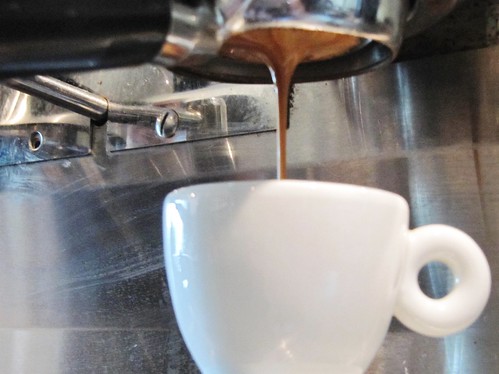
Showing posts with label tasting. Show all posts

Wednesday, September 07, 2011

Improving Clarity

When it comes to coffee and espresso, clarity is important. We've had the same filtration system since we opened, and it's time to improve it. I've been wanting to upgrade our water filtration for a while now. I've ordered two Everpure Claris filter systems.

It is an adjustable filtration media that includes a five stage process for eliminating scale, dirt and fine particulates, odors/off flavors. I believe that for the money and simplicity it's the best system out there.


The Claris uses a Hydrogen (H+) ion exchange rather than a Sodium (Na+)exchange.

"The Claris resin is loaded with hydrogen (H+). The hydrogen ions dissolve the carbonates (CO32- and HCO32-) , and the resin then removes the calcium and magnesium ions (Ca2+ and Mg2+). This process also lowers the pH."


I will soon find out how it tastes.

Wednesday, August 31, 2011

Espresso: Too soon is never "too soon"

Sometimes espresso is too fresh to use. But there are times when I need to pull shots sooner than expected. I usually wait several days after roasting before testing my espresso, but since we we're sold out on whole bean espresso, I needed to test a couple days earlier than usual.

At altitude espresso acts differently than at a lower elevation. What might be good at three to five days rest near the coast might need closer to seven days at altitude. So testing at less than 48 hours here involves some forecasting and manipulation.

I grind on the ultrafine end of espressodom, and knowing my components, I say 17 grams. Now keep in mind I'm just looking for tasting notes, not perfection at this point.

I pull the first shot and the crema is outrageously wild.

I tighten the grind a little more.


The crema is manageable and the aromatics are off the charts. Smell. Sip. Pause while my brain runs through my limited tasting vocabulary. Sip. Develop a mental tasting picture of the espresso. Finish. Ponder.

Now I stop pondering to think, and as I ponder my thoughts, I

Name it. Write it. Bag it.

Done.

"Soul Finger" -

This jazzy cacophony of flavors will leave you shouting joyously to the open ears of frantic handless pantomimes.

This three bean blend brings coffees from Sumatra Mandheling, Ethiopia Guji Quto Suke and a wonderful coffee from San Martin de Leon Cortes.

In the cup it's rhythmic raspberry and stone fruit with a punctuated praline-toffee sweetness.
Recommend: 198.5 – 199F, 17g, 28 S.

And it tastes exactly like it sounds.

This will be something special.

Friday, August 26, 2011

Good Methodology = Good Espresso

I love testing new espresso. I also love testing whether or not something will work as a Single Origin espresso or as a component for espresso. Today I had some extra Guji Suke Quto from last night's tasting class. Now I've used this as a component of an espresso, but I haven't really tried it as a Single Origin. Golden opportunity. This allowed me the opportunity to test without roasting an entire new batch, and if the roast level I used for the coffee will work or not.

So the question I am asking is, "Does it work?"

I'm pretty systematic about my testing. I know what range of grind to target, so I pick a midpoint and start from there. I keep the Synesso at the temperature set for the current espresso (199 F). No need to change until after I taste... but that's still a bit away.

One step at a time.

I tare the portafilter and grind. How much? I guess and see where I'm at. 17g. Ok. Tamp. And as Captain Picard says, "Engage!"

First I'm just watching for flow. It's too fast.

I adjust the grind a little finer. I dose the same weight. Looks a little better...
I'll give it a taste. Sip. Mild citrus, hint of nut. ... good, but it seems like it's lacking something. It's not a one dimensional coffee. I know there's more there. I just have to find it.

Let's approach 18 g.

Puck looks pretty good.

I always pull a second one so I know if it was a fluke or not, and it looks the same.

Taste.

Bingo!

First sip - Candied ginger, sweet citrus and jasmine. Second sip - warm spice, a touch of bergamot, honey sweetness. Finish - dark honey to maple sweetness, restrained citrus, hint of spice.

Does it work?

I'd say, "Yes." But it's not that simple.

All coffees aren't this easy. Even when they work. Sometimes I go through ten or twelve shots and I'm about to give up, then everything comes together. And then it fades. The real question isn't "Does it work?" The real question is, "Can I do that again?"

Well, can I?

Grind. Dose. Distribute. Tamp.

Taste.

And the answer is

.
.
.

Yes!

Thursday, August 18, 2011

Espresso is a harsh mistress

Are you thinking about having a shot of espresso? You should be! Espresso is quick, small, packed full of flavor, and when you sip you can hear a heavenly chorus in the distance, and you know the wonderful experience unfolding before you. At least, that's how it should be.


I am amazed and bewildered at what people have accepted as espresso. Bitter. Sour. Thin. Unpalatable. And it's usually because there is little respect or understanding for the ingredients being used.

Yes, espresso is a harsh mistress, fraught with eccentricities that make her either a delight or a beast. Dismiss her complex nature, and she'll bring hell upon you. But make no mistake, if you tame her, she will bring you pleasure beyond compare.

So the next time you are looking to have a shot of espresso, make sure that she is being treated with the respect she deserves. You will be kindly rewarded.

Sunday, December 14, 2008

The Varietal Language of Coffee

I grew up with the same coffee that many of you did. Somewhere between something that was mountain grown, and the local cup of Joe that could have been substituted for paint thinner. This was the time when coffee mumbled. Unintelligible mutterings that continue to linger in many dank holes today... but let us go back....

There was this generic coffee flavor that we linked with all coffee. Aromatic, yet bitter, deep, but unremarkable, character, yet sameness. Whether it be the standard Colombian or something exotic like Kenya... it pretty much all tasted the same. And when it was different, we tried to mirror that sameness by matching the preconceived coffee flavor in the dark recesses of our mind by flattening out the bitters, sharp tones, and burnt staleness by a glob of sugar and a plop of milk. As we created some artificial semblance of coffee like flavor, we were satisfied that we could take something that was unpalatable and make it... well, recognizably average.

There are a growing number of farmers, roasters, and coffee professionals that hear the bean speaking to them. At first, it was some coded language, but it was the farmers who first understood that although the beans shared a common history, they had all developed their own language. Coffee speaks to us, but not in words, or sounds, or symbols. Coffee speaks to us in flavors.

As we listen to what the bean is telling us, we can learn, through cupping, and by maintaining a varietal roast what stories they have to share. The history of the cultivar, the feeling of the land, the heart of the farmer, the care of the millers and the sorters, the science and skill of the roaster, and the love and passion of the barista all combine to tell the story of each coffee to the world.

Each cup we serve speaks volumes, and like a pristine first edition, we savor every word as it linguistically flavors our tongue. So when you have a moment to savor the unspoken word of coffee, educate yourself by the cup and pass on your knowledge to others by sharing a taste of the varietal language of coffee.

Saturday, August 23, 2008

Ethiopia Koratie DP -- in the Siphon

Wow!

This coffee was roasted to a dark city, almost full city roast... but I would do it at a lighter City roast next time to highlight the sweeter flavors.

In the cup the initial sips are blueberry up top and peach on the bottom. Midway through the cup a tiny hint of melon flavors begin to come through, though still surrounded by the blueberry.... and a bit of bitter cocoa in the background.

Blueberry and cocoa begin to dominate as you finish the cup. It finishes with a blueberry bittersweetness. I believe that the sweeter fruits would be more prominent and balanced at a lighter roast. I will report on that next time.

Total brew time on the siphon: 45 seconds - 35 brewing up, 10 to descend.

Saturday, July 19, 2008

The "Incident" - An Observation

Some of you may be in the dark regarding the "Incident" at Murky Coffee in D.C.

There has been literally thousands of comments across the blogosphere regarding this tiff, and it brings some important issues to light:

This is not your father's coffeeshop.
Coffee has progressed incredibly over the past twenty-years, from the farmer cupping their lots, testing various drying methods, utilizing the science of cultivation--which can create a higher quality bean, to the artisan barista who spends countless hours understanding dosing, leveling, and extraction techniques... and who has to master the nuances of each espresso just as a concert pianist masters various pieces of classical music.

Several coffeeshops across North America have raised their standard of coffee and espresso quality to be greater than the food quality of most high end restaurants. It is the average shop, where over-roasted bitterness is the norm, that continues the thought that coffee is a method of caffeine injection, rather than a culinary experience. For these handful of shops that treat coffee as a culinary experience AND deliver it, a higher standard of respect should be given by their customers, as well as a higher level of decorum should be present in the barista.

This begs the question,

"Can we serve an exceptional product while maintaining a casual atmosphere and expect a high level of respect from the customer?"
There is a casual elegance you can find in many restaurants. Take a look at some of the seafood restaurants in San Fran as an example. Shorts, nice shirt, maybe even sandals... dinner for two, $400+
Is it a product of the atmosphere? Of the pricing? Is it a matter of revamping the entire atmosphere to elicit a different response, a different expectation from the customer?

These are questions I have been thinking about for a few years now and while I have a few solutions in mind... it is the implementation that is hardest. But I do believe you can raise the standard by raising the expectation through better presentation and consumer coffee education.

But the customer wants...

When you get a McFish from the Golden Arches it is entirely different from ordering the Seared Ahi Tuna loin at Charlie Trotter's; the same holds true for coffee.

Quality isn't for the Everyman, and rather than try to appeal to everyone, customers are given the best service by a continual raising of standards along with continued pursuit of excellence in our craft. All of this translates to an exceptional cup, and that is the greatest reward we can give.

Friday, July 11, 2008

Brazil Fazenda Esperanca: a few days later

I've enjoyed several more cups of this coffee in the past two days, and as time has progressed, the flavor nuances have become a little more defined, and the caramel-citrus finish is a bit longer.

I can't quite put my finger on some of the flavors I am getting in the middle of the cup. I'll have to give it a go again, but in a few words, it's good, really good.

Wednesday, July 02, 2008

Espresso timing vs. flow

Observations of the day.

Most of us are familiar with the "Golden Rule" when making espresso -- 3/4 to 1 ounce of espresso in 25-30 seconds, or roughly double that volume for a double shot. When pulling a shot of espresso, how concerned should you be with the timing? How concerned should you be with the flow?

Obviously a combination of both must factor into play, but without going into the myriad permutations you can have of this or that, you come down to the main questions..

Too fast or too slow, which is worse?

There is always an ideal range you want to fall in, but between the two, you would rather have a thirty-five second or greater pour than a sub twenty second pour.

This is because espresso, in layman's terms, is about extracting the optimum amount of flavorful oils from the grounds. But how do we determine if this has happened?

I use timing as a 'rule of thumb' guide and then primarily watch flow and inspect the portafilter to see if it is clean. If the portafilter is clean, and the timing fell in the optimal range, we can assume that the oils were extracted perfectly, and made it into the demitasse. If there are dark oil stains on the inside of the portafilter, this is usually an indication of overextraction... or poor distribution, but that's a topic for another time.

If we underextract, as many places do, and get that eleven second pour, there are virtually no flavorful oils being extracted, and unflavorful piss-like espresso will usually be the result. I can opt for intense at times, but unflavorful, weak espresso is a far worse crime.


How important is the flow?


Flow is important because it gives one a good indication of the color and density of the crema. While the existence of crema is not the end all be all of espresso, it is most certainly one of the most important factors. Crema is important because of all of the body, texture, flavor, and aroma it gives to the espresso.

It's never a simple process, but evaluating espresso by taste is the ultimate way to judge, so whether there are dark oil stains in the portafilter or it was a thirty-eight second pour, we have to use our palate as the ultimate judge. Of course, in my opinion, a great tasting espresso with indicators that it is somehow flawed can only mean there is more improvement ahead.

While this is not intended to be anywhere near a deep exploration of the subject, I hope it will at least get your brain churning.

Tuesday, July 01, 2008

Rapid Brewing with the Finca El Injerto

Today I tested a fresh (roasted 10p last night) batch of Guatemala Finca El injerto on the siphon.

Grind 3 notches from 'espresso' on Mazzer Mini.
Brew time 20 seconds.
Rapid stir.

The taste? sweet nut, floral, light caramel and a bit of cocoa.

Wow.

Saturday, June 28, 2008

Mountain Mambo Espresso

While the main components of this blend remain the same, I often alter percentages and experiment with different pre and post blending methods as well as different roast levels. This way, I can discover flavors I may have missed or lost with some other combination.

This current batch as espresso is peach, mango, light bittersweet almond and hints of honey and chocolate. In cappuccino, it tastes like a peach/apricot creamsicle up front with the almond taking on a lighter, but sweeter role. Not recommended for drinks above 12 ounces.

This espresso is not for the choco choco dark caramel and wood crowd.
But for those looking for a bright, lively, multi-dimensional espresso--this is it.

Saturday, June 21, 2008

Kenya AA Nyeri Kiamaina *Tasting Notes*

John Says...

Today I tested a batch of the new Kenya AA Nyeri Kiamaina.

This batch was roasted to a City Roast at 9:00 AM this morning.
Testing was done at 6:00 PM.

I brewed several batches in the Siphon brewer, and even on day one, the flavors are coming through. Peach and maybe a hint of floral apricot in the aroma. Peach and lemon up front, with the peach dominating as the cup cools. A sweet and balanced finish of peach and honey.

I found this coffee to be exceptionally clean, even by my radical standards. It's truly a magnificent coffee and creates a cup you will long remember.

Friday, June 13, 2008

Pursuing Perfection with Panama: Siphon Techniques

John says...

Today I am testing the Panama Carmen Estate
This coffee was roasted 9 days ago at a City roast.


Test 1:
Grind at 4 notches above espresso grind on Mazzer Mini.
9 grams coffee, 5 ounces water.
Coffee in. Water Boil and up. Stir to saturate grounds and distribute heat evenly.
Brew 40 seconds.
Heat off.
Stir Rapidly.
Cool and drink.

Test 2:
Grind at 2 notches above espresso grind on Mazzer Mini.
9 grams coffee, 5 ounces water.
Coffee in. Water Boil and up. Stir to saturate grounds and distribute heat evenly.
Brew 40 seconds.
Heat off.
Stir Rapidly.
Cool and drink.

Results.

This coffee being roasted a hair lighter, my suspicions were found to be true.

Test 1 was a balanced peach/vanilla with very subtle, yet sweet citrus notes.
As the cup progressed the citrus became more defined, but surrounded by an essence of vanilla.

Test 2 had more separation up front in the cup. Strong Peach notes with a bright citrus aftertaste. As the cup cooled, the vanilla came out and began to mingle with the peach.

The finish in Test 1 was sweet light citrus.
The finish in Test 2 was a bright citrus with the slightest hint of vanilla.

What does this tell me?

It's obvious that even with a small adjustment, there is a direct correlation between roast level and grind. And it is the balancing of the sweet, citrus, and more rounded, or even spice notes that are where the technique comes into play.

Tomorrow I will use the same method on the Papua New Guinea Peaberry, which has a lot of spice and tea notes.

more to come...

Thursday, June 12, 2008

Revisiting Rwanda - Siphon techniques

Today I am testing the Rwanda Kinunu.
This coffee was roasted 6 days ago at a City+ roast.


Test 1:
Grind at 4 notches above espresso grind on Mazzer Mini.
9 grams coffee, 5 ounces water.
Coffee in. Water Boil and up. Stir to saturate grounds and distribute heat evenly.
Brew 40 seconds.
Heat off.
Stir Rapidly.
Cool and drink.

Test 2:
Grind at 2 notches above espresso grind on Mazzer Mini.
9 grams coffee, 5 ounces water.
Coffee in. Water Boil and up. Stir to saturate grounds and distribute heat evenly.
Brew 40 seconds.
Heat off.
Stir Rapidly.
Cool and drink.

Results.

Both the aromatics and coffee on Test 1 were slightly sweeter. A little more fruit and citrus note.

In the middle of the cup, Test 2 tasted more complex. It was a collection of flavors coming together vs. a layered effect of lighter and brighter vs. wood and nut/spice.

The finish in Test 1 was superior.

Preliminary Conclusion:
Do same test on Panama Carmen Estate and see if the results are similar, or is the method entirely coffee dependant?

Stay tuned...

Saturday, April 05, 2008

New Syphon (siphon, Vac Pot...)

I received a package from overseas yesterday.
I am testing some new coffee syphon, a 3 cup and the awesome 2 cup.
So far they are working well. I am looking for exclusivity, so I'm being fairly rough with them. I will run some more rigorous tests, but it looks like we may have a winner.

Wednesday, November 07, 2007

Tasting Notes - Panama Carmen Estate

I have been enjoying this coffee for about six days now, and it still ranks as one of my favorite coffees. This particular lot is a from micro-lot picked from only 1800 meters and above. As the internal sugars in the bean increase with every hundred meters in elevation, this is a sweet and pristine cup.

Almost crystalline in clarity, distinct vanilla, peach, and a sweet cherry tone throughout. A nutty and smooth body lends to a pleasurable cup.

When I brew this particular coffee, I look to a finer grind and a steep time of about three minutes in the press pot. It's a remarkable tasting journey and a highly recommended coffee even first day out of the roaster. You'll be amazed.

Tuesday, October 30, 2007

Tasting Notes - Organic DP Ethiopian Sidamo *Special Selection* -- Tasting Notes

I played around with this coffee for a while and decided to try it at as a blend at three different roast levels. I'm getting blueberry and cherry skins right off the top with a bittersweet spice not throughout the cup. Chocolates here and there, but it's as if the spice notes morph into chocolate and the chocolate morphs into spice.

My current batch was roasted on the 26th of October, and is coming along very well in the cup.