Showing posts with label syphon. Show all posts

Thursday, September 28, 2017

Make Something Beautiful

As each year passes, the accessibility of information increases while at the same time there is an equal increase in bad information. Much of this bad information comes from a lack of expertise and skill with a healthy dose of sloppiness. An audience of watchers and viewers comprised of people with even less expertise makes them perfect for advancing bad information. There is an overabundance of poor technique and flat out wrong information permeating throughout the coffee industry. There is no beauty in bad information. Bad information leads to an ugly tasting cup of coffee.

Siphon coffee brewing is near and dear to me. I'm pretty good at it - not that articles, awards, and acknowledgement from peers means anything, but... it does. There's not a lot of siphon brewing going on out there compared to other forms of coffee brewing, and most of it is being done wrong. A video from the World Siphon Brewing Championships was sent to me and it was disturbingly bad. It was no surprise when the person who sent it was told "the coffee is terrible". I have also seen countless badly executed cups from a certain company's "Reserve Bar," and it's the perpetuation of bad information and poorly executed coffees that continues... and that is bad.

Here are some screenshots from a recent video of a "professional demonstration". I did my best to conceal the identity of the subject, but it is what it is.

The first thing that clearly illustrates this barista's lack of expertise is something that I can't show because it didn't happen. Fresh grinding. I have no idea when the coffee was ground, but it certainly was not ground immediately before brewing as there was a lot of lead time and no coffee grinding. Any time before the video started would have been too long. This shows a lack of care in one of the most essential steps for any coffee brewing and even more important for a demonstration of craft-brewed coffee. Unprofessional.

This first picture below shows the water ascended into the top flask of the siphon. This is a clear indication of lack of understanding of the most basic coffee brewing principles. The next picture will show why.


The horror! The horror! If you are a coffee professional and are not cringing at this, maybe you should rethink your profession.


Here's the issue: Think about every other coffee brewing technique you know. The water meets the coffee. The coffee does not meet water. Pour over/Drip - coffee grounds in a cone, water poured over coffee grounds. French Press - coffee grounds go into the press pot and water is poured in. And the principle holds true for espresso - coffee grounds go in the portafilter and the water comes down to meet them. This is a basic nuts and bolts explanation: The importance of pre-wetting and even, controlled saturation allow for the water to penetrate and work its way past the surface of the cellular walls and bring out the oils out from within the tiny cellular structure of the coffee.Having all the grounds hit the water at once do not allow for any gradual or even pre-wetting and the immediate exposure to the full temperature of the water causes only the oils from the outermost cells to "pulse" out while essentially sealing the other flavorful oils within the deeper cellular structure. So in a nutshell, If you don't have proper order of technique, ... "water meets coffee," then because of what happens to the oil and because of what doesn't happen to the oil you create both off flavors and an incompleteness of flavors... not so much in intensity, but very much so in terms of nuance and dynamics.

In this next picture there are two problems that I notice one of which goes back to the beginning. And if you start with bad technique then you are likely to finish with bad technique.

The first problem: Look at the top of the siphon, at the haphazard mess of grounds there. No even dome. No real dome at all. So no stirring immediately after brewing which compromises the extraction that occurs during the draw down.

The second problem: look at how much coffee was brewed in the siphon. Just because you can put that much liquid in does not mean you should. In order to maximize the flavor extraction in a siphon brewed coffee, it's about understanding how each element contributes to the cup and then balancing all of those elements together to get the proper result. Due to the correlation of particle size, extraction rate, and draw down time, the ideal water level for a "3 cup" siphon is about the middle of the bulb which is approximately the "2 cup" mark.


It takes time to develop expertise. Those who have some level of expertise never seem to be satisfied with the status quo -- which is why they were able to achieve a notable level of skill in the first place. Whatever your craft or discipline happens to be, don't be blinded by fancy words, strong personalities or great branding. It's a combination of laziness and not caring that leads to the dissemination and acceptance of bad information. Take the time to use your mind to assess, to understand, and to know the difference between good and faulty information.

For a correct demonstration of siphon coffee brewing watch my appearance on FOX 13 from Memorial Day 2017.


Whether it's brewing coffee or life in general, don't be sloppy when you can make something beautiful.


Thursday, July 13, 2017

Understand the Process

Process is important. “Understand the process,” I say. But what does that entail? Is “process” simply a set of steps you follow to accomplish a task correctly – In this case brewing coffee?

Yes.

So, we're done then?

No, we're not. Because as straightforward as it should be, to everyone's dismay (not really) there are few professionals who get it right. What are they not doing right and WHY are they not doing it right?


Let's start with: What is the process?

In a nutshell: Start with properly roasted, quality, fresh, (whole) coffee beans. Understand correct dosing (coffee:water ratio) and particle size. Use correct dosing for chosen brewing method. Grind fresh with a good, adjustable burr grinder. Use water within (generally) specific TDS parameters. And brew! Then taste and adjust until it's just right. All of these steps are taken in order to produce a specific result – excellent coffee.

Now let's work through these “simple” things and see where the problems are.

Quality coffee – Now there are cupping scores and tasting notes in respect to the green coffee. So, as a coffee roaster it's simple to get your hands on quality beans. And I would suppose that most coffee shops who are making a claim of craft, artisanal, or “Third Wave” coffee are, in fact, sourcing quality green.

Properly roasted – Here is where we need to take a closer look. Because as I have often said, the higher the quality of your green, the more complexity within that specific lot, the more skill it takes to roast it.


So, what does “highly skilled” as a roaster mean? Is it about experience and dedication? Is it about talent?

I think if I had to list these factors it would be: talent, dedication, and experience. And when I talk about dedication, I think you can use the word “dedication” as a more serious sounding replacement for the word “passion”. You can't be dedicated to a thing without loving or enjoying that thing. And the dedication isn't simply to the craft. It's a dedication to the result of the craft, which is excellent coffee. With dedication and experience, you can always be above average to really, really good. But in my experience, without some inherent skill, aptitude or talent for the craft, you will never be exceptional.

So the first weakening of the process is with the roasting? What is the talent level of your roaster? How many hours of work have they put in? How many varietals from how many regions have they roasted? And how many years have they been doing it? Whether YOU are the roaster or your shop does the roasting, or you bring in your beans from somewhere – in which case you have to ask all these questions about their roaster – the likelihood is perhaps your coffee program isn't on as solid a ground as you were led to believe or that you are leading others to believe.

Now, I could really stop there, because the roasting of the coffee is probably the most important step in the coffee making process.

But let's assume the roasting is spot on.

Correct dosing is a known thing, so there's really no excuse for getting that wrong Look up “Gold Cup” standards or SCA brewing standards. Coffee science doesn't change.


Grind size is a generally known thing that you specifically tune to your coffee and your taste.

The same can be said for water chemistry.

Brewing technique? That takes a bit of skill. It takes some practice. And of course the goal again... excellent coffee.

So the reasons for not executing excellent coffee?

Either you don't know how. Or you don't care to know how. Often it's both.


If you care about the prestige of sourcing excellent coffees, but don't take the time to make sure you have a highly experienced roaster who can create sweetness and dynamic complexity and balance and mouthfeel in your coffee – then what?

Well, what happens is if the fundamentals of your coffee program are not rock solid, the smaller details, like brewing parameters or water chemistry are going to be an afterthought as well.

Or do you try to unknowingly take short cuts? You have a refractometer of some sort, you measure TDS to perfection... you dial in temperatures precisely, and what you do is end up chasing numbers instead of following flavor.

Great coffee, excellent coffee, exceptional coffee is not the result of following a set of numbers.
Exceptional coffee is the result of understanding the process with the end goal of a delicious cup of coffee. This means fundamentals of brewing and this means following the flavor.


It's really simple. Everyone should be able to do it.

You should be able to do it. So why aren't you?


Tuesday, June 06, 2017

John talks coffee #4 - Tasting - Understand Why

The reason you taste and adjust, is not simply to make it better. It's to understand why the new version tastes different than the old version. Don't just ask why, know why!


Monday, June 05, 2017

John talks coffee #3 - Knowledge of Craft

Understand the coffees that you are using, understand how they work at various roast levels and different profiles. The more you understand how the depth and breadth of your coffee, the more you will understand - and create a great espresso.


Saturday, July 18, 2009

The Best Cup of Coffee - caffe d'bolla's siphon brew

The best cup of coffee
› Caffe d’Bolla’s siphon brew

"This is not your breakfast cuppa java—you may not have time for your usual second cup. Caffe d’Bolla’s transcendental coffee is brewed by a master fanatic who pays as much attention to making your single cup as he might to walking a tightrope without a net. It deserves to be savored just as attentively. 249 E. 400 South, SLC, 801-355-1398"

Salt Lake Magazine link HERE

Saturday, May 23, 2009

Siphon Brewing and Commitment to Excellence

Recently, we were noted in Salt Lake City Magazine as one of Utah's Must Try Culinary Creations.

"47. A cup of siphon coffee

Chances are good that you’ve never tasted a cup of coffee like this. That means, in a sense, you’ve never really tasted coffee. It takes a coffee fanatic to think the resulting cup is worth the science project of making it. Fortunately, Utah is a great breeding ground for fanatics of all types. Caffé d’Bolla, 249 E. 400 South, SLC, 801-355-1398, caffedbolla.com
saltlakemagazine.com

Achieving excellence in any endeavor is more about the commitment to the process of excellence, rather than just to excellence itself. For us, sourcing great coffees is just the beginning. Several trips to Japan, talking to and filming siphon barista there as well as tweaking roasting profiles and having an insane dedication to have absolutely no cream or sugar in our siphon coffee has helped us to get people to see coffee in a whole new light. People plan their driving routes on vacation to stop and have coffee, they've been late for airplanes, delayed meetings, changed office locations to move here, and in some cases flown across country, just to have a cup. Would I say it's the best cup possible? No, but I won't admit to being second either.

Coffee is at a crossroads, you can truly do something great to showcase the coffee, or you can spend a lot of money on glitz and hype. While McDonalds is out there demeaning coffee and the barista profession, rather than just laughing it off we all need to continue to raise the bar.

In order to truly raise the bar, it's not just the passion, or coffee knowledge... because there are countless roasters, barista, and others that have loads more technical coffee knowledge. The problem is, they don't have the commitment to back it up. Why source spectacular coffees, some even farm direct and serve them as "drip". It makes no sense to me at all. Press, Melitta, Eva Solo, Siphon, etc. Great coffees should be made by the cup, and to do otherwise really means you're not committed to the coffee. Don't just say you're committed to giving the best coffee has to offer, do it, and don't compromise. That is what we have been doing since we opened. I'm hoping many more will follow.

Saturday, November 01, 2008

The Siphon Bar

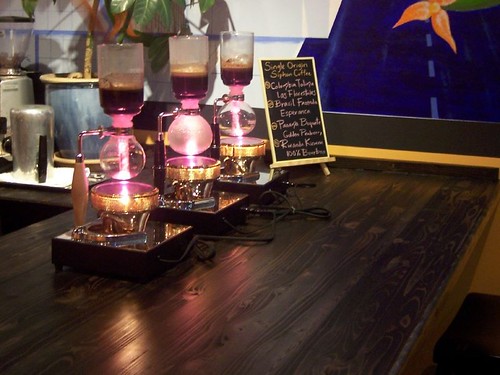
We are just finishing our second week with the siphon bar at caffe d'bolla and the results are starting to come in.


The Siphon Bar has created a lot of new conversation about the coffee and the brewing method. I believe that this is the best way for extracting the dynamic varietal flavors out of the coffee.


Clean and dynamic
brewed above shimmering light
coffee perfection.

Friday, July 11, 2008

Brazil Fazenda Esperanca: a few days later

I've enjoyed several more cups of this coffee in the past two days, and as time has progressed, the flavor nuances have become a little more defined, and the caramel-citrus finish is a bit longer.

I can't quite put my finger on some of the flavors I am getting in the middle of the cup. I'll have to give it a go again, but in a few words, it's good, really good.

Wednesday, July 09, 2008

More to come!

Our 3000 pound shipment from overseas has arrived!

Siphon brewers and accessories, and wonderful new teas will be available soon!

Tuesday, July 01, 2008

Rapid Brewing with the Finca El Injerto

Today I tested a fresh (roasted 10p last night) batch of Guatemala Finca El injerto on the siphon.

Grind 3 notches from 'espresso' on Mazzer Mini.
Brew time 20 seconds.
Rapid stir.

The taste? sweet nut, floral, light caramel and a bit of cocoa.

Wow.

Saturday, June 21, 2008

Kenya AA Nyeri Kiamaina *Tasting Notes*

John Says...

Today I tested a batch of the new Kenya AA Nyeri Kiamaina.

This batch was roasted to a City Roast at 9:00 AM this morning.
Testing was done at 6:00 PM.

I brewed several batches in the Siphon brewer, and even on day one, the flavors are coming through. Peach and maybe a hint of floral apricot in the aroma. Peach and lemon up front, with the peach dominating as the cup cools. A sweet and balanced finish of peach and honey.

I found this coffee to be exceptionally clean, even by my radical standards. It's truly a magnificent coffee and creates a cup you will long remember.

Friday, June 13, 2008

Pursuing Perfection with Panama: Siphon Techniques

John says...

Today I am testing the Panama Carmen Estate
This coffee was roasted 9 days ago at a City roast.


Test 1:
Grind at 4 notches above espresso grind on Mazzer Mini.
9 grams coffee, 5 ounces water.
Coffee in. Water Boil and up. Stir to saturate grounds and distribute heat evenly.
Brew 40 seconds.
Heat off.
Stir Rapidly.
Cool and drink.

Test 2:
Grind at 2 notches above espresso grind on Mazzer Mini.
9 grams coffee, 5 ounces water.
Coffee in. Water Boil and up. Stir to saturate grounds and distribute heat evenly.
Brew 40 seconds.
Heat off.
Stir Rapidly.
Cool and drink.

Results.

This coffee being roasted a hair lighter, my suspicions were found to be true.

Test 1 was a balanced peach/vanilla with very subtle, yet sweet citrus notes.
As the cup progressed the citrus became more defined, but surrounded by an essence of vanilla.

Test 2 had more separation up front in the cup. Strong Peach notes with a bright citrus aftertaste. As the cup cooled, the vanilla came out and began to mingle with the peach.

The finish in Test 1 was sweet light citrus.
The finish in Test 2 was a bright citrus with the slightest hint of vanilla.

What does this tell me?

It's obvious that even with a small adjustment, there is a direct correlation between roast level and grind. And it is the balancing of the sweet, citrus, and more rounded, or even spice notes that are where the technique comes into play.

Tomorrow I will use the same method on the Papua New Guinea Peaberry, which has a lot of spice and tea notes.

more to come...